📋 Contents
- 1. The riddle of the shaded zone: What is Constant Power?
- 2. Breakdown of versions: what is the difference between L, M and H models?
- L Version (Low Current / High Voltage)
- M Version (Medium Current / Medium Voltage)
- H Version (High Current / Low Voltage)
- 3. Practical calculation: How to use the graph
- 4. Interactive calculator of working zone (I-V curve)
- 5. Important tips for operation
- Conclusion
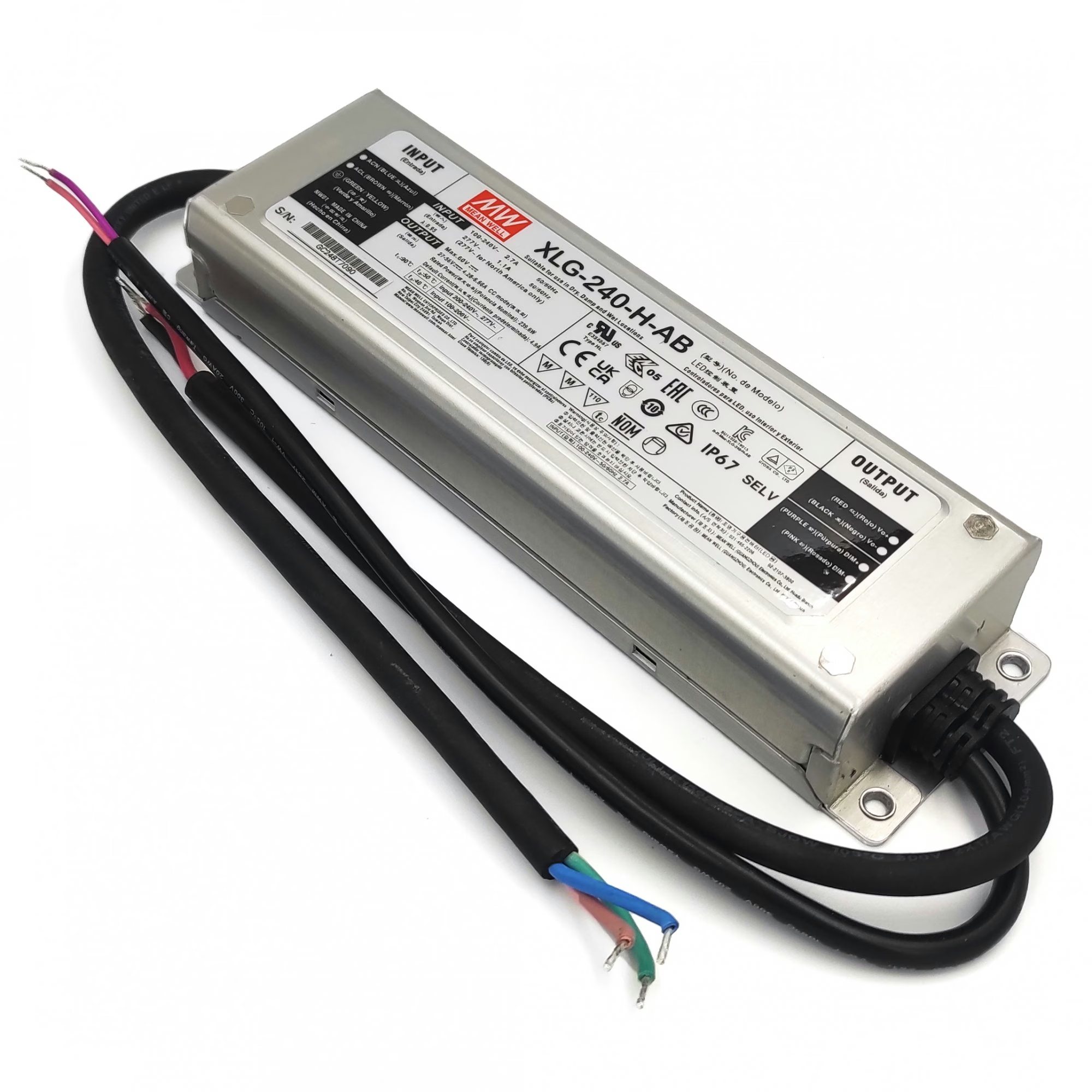
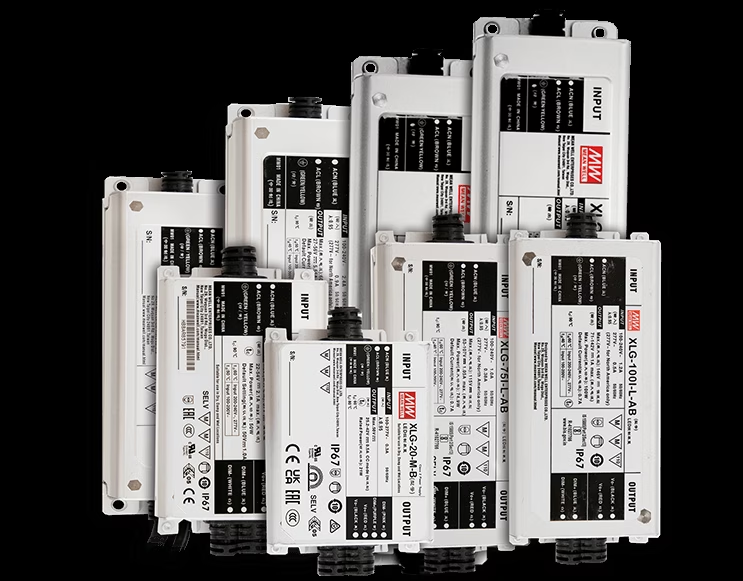
In this article I want to talk about the incredibly popular and versatile line of LED drivers for LEDs from Mean Well of the XLG series (with a power from 100 to 320 W), this model became a real hit among engineers due to its reliability, compactness and a 5 year warranty.
XLG series LED drivers are applied in:
- Architectural lighting (skyscrapers)
- Street lighting
- Floodlight lighting
- Stage lighting
- Fishing lighting
- Horticulture lighting (gardening and greenhouses)
- Industrial lighting (High-bay luminaires)
- Powering LED strips (for ABV modification)
- Agricultural lighting (for ABV modification)
- Type HL for use in hazardous locations
The application area of these drivers also covers people who love DIY projects. Not all of them are experienced engineers in the field of electronics or electrics. Upon first acquaintance with the official documentation (datasheet) of the Mean Well XLG series drivers many face a difficulty. Instead of the usual single figure of maximum current, the datasheet presents a complex polygonal graph, the so-called volt-ampere characteristic (I-V curve), or I-V Operating Area. An example of graphs from the original datasheet for a 240W driver, models XLG-240-L, XLG-240-M, XLG-240-H:
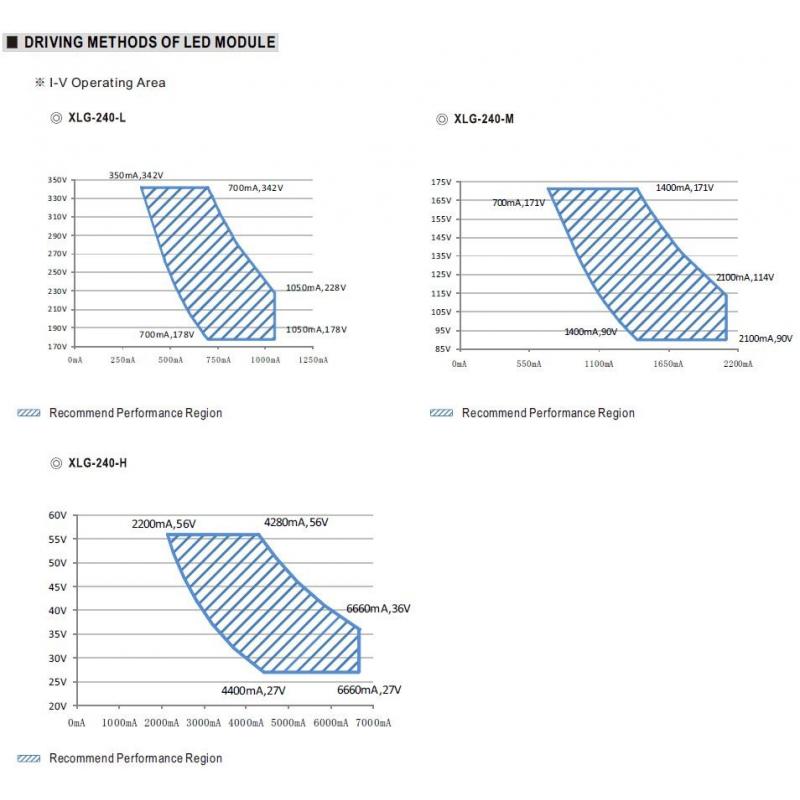
In this article we will analyze in detail, how to correctly read these graphs, what Constant Power mode is, what the fundamental difference is between versions L, M and H, and how to safely calculate the output current for your LEDs.
1. The riddle of the shaded zone: What is Constant Power?
Most LED drivers worked in a strict Constant Current (CC) mode — constant current. If the driver is rated for 1050 mA, it will output exactly 1050 mA, adjusting the voltage to the matrix in the specified range of voltages. Going beyond these limits led to the shutdown of the device, activation of the protection mechanism.
The XLG driver series uses a more advanced topology — Constant Power (CP), or constant (nominal) power mode.
Constant Power mode means that the driver allows you to flexibly vary voltage and current, maintaining maximum output power. If you use an LED assembly with a lower operating voltage, the driver is able to give more current, to compensate for the difference and output the claimed Watts. Accordingly and vice versa at a high voltage on the LED assembly, the maximum current that the driver can give will decrease.
Exactly this principle is displayed on the graph in the datasheet in the form of a shaded area "Recommend Performance Region".
- The right curved boundary of this polygon — is the physical power limit of the driver.
- The top and bottom boundaries — voltage limits.
- The left boundary — is the minimum recommended current (usually about 50% of nominal), at which the driver maintains high efficiency and stability.
To work inside this shaded zone — means to use the driver as efficiently and safely as possible.
2. Breakdown of versions: what is the difference between L, M and H models?
LED matrices (COB, Quantum Boards, SMD strips) have cardinally different operating voltages. To cover all market needs, Mean Well engineers divided the XLG series (in the power range of 100W – 320W) into three modifications: L (Low), M (Medium) and H (High).
The letters denote not the power, but the output current level (and, accordingly, the inverse dependence of voltage).
L Version (Low Current / High Voltage)
- Characteristic: Low current, high voltage.
- Range (using 240W as an example): Voltage from 178 V to 342 V; Current up to 1050 mA.
- What it is needed for: Ideal for series connection of a large number of LED modules (daisy-chaining). Often used in street lights (Street Lighting), where long chains of LEDs create a high voltage drop, but require a small current to reduce heating of the conductors.
M Version (Medium Current / Medium Voltage)
- Characteristic: Medium current, medium voltage.
- Range (using 240W as an example): Voltage from 90 V to 171 V; Current up to 2100 mA.
- What it is needed for: Universal solution for industrial lights (High Bay) and series-parallel assemblies. Excellent choice, when you need to power 3-4 standard LED panels (40-50 V each), connected in series.
H Version (High Current / Low Voltage)
- Characteristic: High current, low voltage (safe for humans).
- Range (using 240W as an example): Voltage from 27 V to 56 V; Current up to 6660 mA.
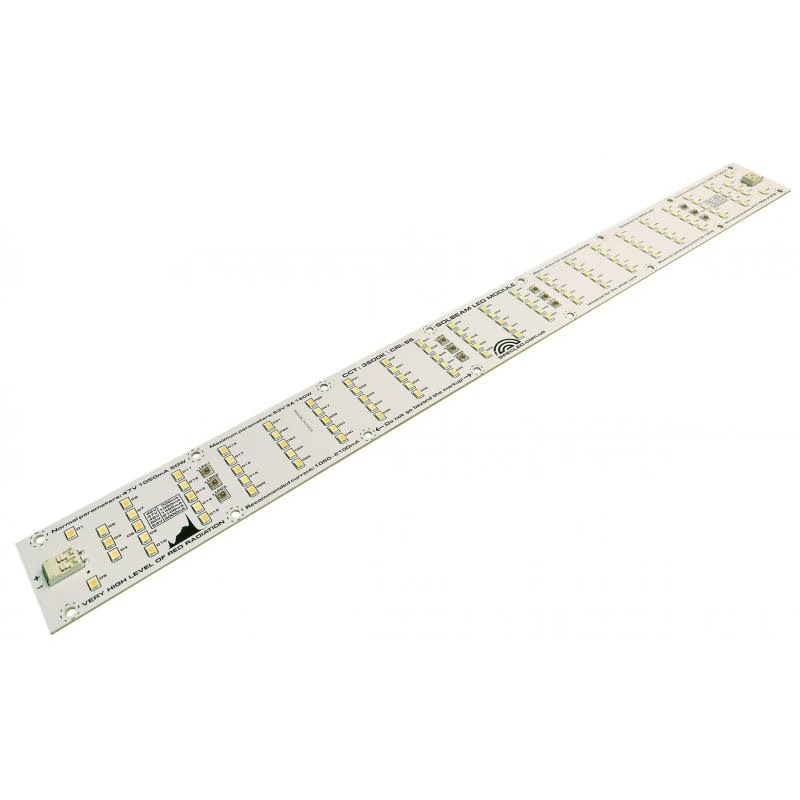
- What it is needed for: Absolute bestseller in the field of phyto-lighting (Grow Lights) and custom home projects. Ideally docks with popular Quantum Boards (which usually work from 44–54 V) and powerful led matrices Citizen/Cree/SunLike. Allows giving huge current at safe voltage below 56 Volts.
3. Practical calculation: How to use the graph
Let's analyze a practical example. Suppose, you are assembling a plant light. You have a powerful LED panel (Quantum Board), the operating voltage of which is 48 V. You bought a Mean Well XLG-240-H driver (240 W power).
Your task — is to understand, what maximum current you can safely apply to the panel, and whether your system falls into the "Recommend Performance Region".
Checking by graph (I-V curve)
- Open the XLG-240-H datasheet on the page with the I-V Operating Area graph.
- Find the value 48V on the vertical axis (Y).
- Draw a horizontal line to the right until intersection with the shaded zone.
- Look down at the horizontal current axis (X).
- We see, that at 48 V the shaded zone starts roughly from 2.2 A and rests against the constant power curve exactly at our calculated 5 A.
P.S. Rare LED modules for plants alone are capable of withstanding a 5A current. Before setting up you need to unscrew the built-in potentiometer fully counterclockwise. Parallel connection of several LED modules with identical voltage drop is allowed, in this case the current is divided conditionally equally.
Conclusion: Your LED module ideally suits this driver. You can configure the built-in potentiometer (in L/M/H-A and -AB driver versions,) to give out any current in the range from 2200 mA to 5000 mA, getting the highest efficiency (up to 93%) and an ideal power factor (PFC > 0.95). I want to note that for drivers (marking -AB) with an external dimmer it is also a "knob" setting up the built-in resistor is also mandatory. An external resistor is needed for dynamic control of the output current the upper limit of which is set exactly by the potentiometer built into the driver which is located under the rubber plug on the bottom cover of every XLG series driver.
4. Interactive calculator of working zone (I-V curve)
I understand, that calculating formulas and applying a ruler to a graph in a PDF file — is not the most convenient task, especially when you need to quickly compare several models (100W, 150W, 200W, 240W, 320W) of different versions.
To save your time and eliminate the risk of error, I developed an Interactive calculator of working zone for Mean Well XLG series LED drivers.
How to use the widget:
- Select the driver model you are interested in from the drop-down list (for example, XLG-240-H).
- Move the slider or enter the exact voltage of your LED assembly (voltage drop on the LED).
- The calculator will instantly build a dynamic slice of the graph and show you the exact range of allowable current (from minimum to maximum) right on the interactive graph.
5. Important tips for operation
When designing lighting systems based on XLG drivers and working with their graphs, remember a few engineering nuances:
- Temperature derating (Derating Curve): I-V graphs are relevant at normal ambient temperature. If your driver works in a hot room (above +50°C), its ability to give out 100% power decreases. Check with the Derating Curve graph in the second part of the datasheet.
- Dimming setup (for AB versions): In models with the "AB" suffix a potentiometer is built in (Vo/Io adjustment). When adjusting the current manually with a screwdriver, absolutely use a multimeter.
- Underloading the driver: Working to the left of the shaded zone (at currents less than 50%) is physically possible, but highly unrecommended. With strong underloading, efficiency drops sharply, pulsations increase (Ripple Noise), and also dimming may work unstably. Try to pick the driver power exactly matching the needs of your LED panels.
Conclusion
The I-V Operating Area graphs in Mean Well datasheets — are not just pictures for engineers, but your main tool for creating reliable lighting. Understanding the Constant Power mode and making the right choice between versions L, M and H guarantees, that your LEDs will serve the claimed 50 000+ hours without crystal degradation provided there is high-quality cooling.
Use our interactive I-V curve calculator for Mean Well XLG series LED drivers, choose drivers quickly and accurately, design the best light for your tasks! If you still have doubts in choosing the right XLG model, contact us via the contact form.