📋 Contents
If you've ever assembled a quantum board grow light or simply follow the horticulture lighting market, you've probably noticed something strange. White Samsung LEDs (the legendary LM301B and LM301H) are packed into practically every single grow light on the market, regardless of wattage. But try finding their deep red—the LH351H 660nm—in fresh supply batches. You won't (or you'll find something on "AliEspresso"). The Koreans have quietly and without much fuss rolled up the development of their colored horticulture solutions.
But why?! Spoiler: it has absolutely nothing to do with technology.
Money rules the world. Samsung LED is a massive corporate behemoth. They print chips by the billions for smartphones, monitors, and street lighting. Against this backdrop, the entire global greenhouse lighting market—even with all the hype surrounding vertical farms—is just a drop in the ocean for them.
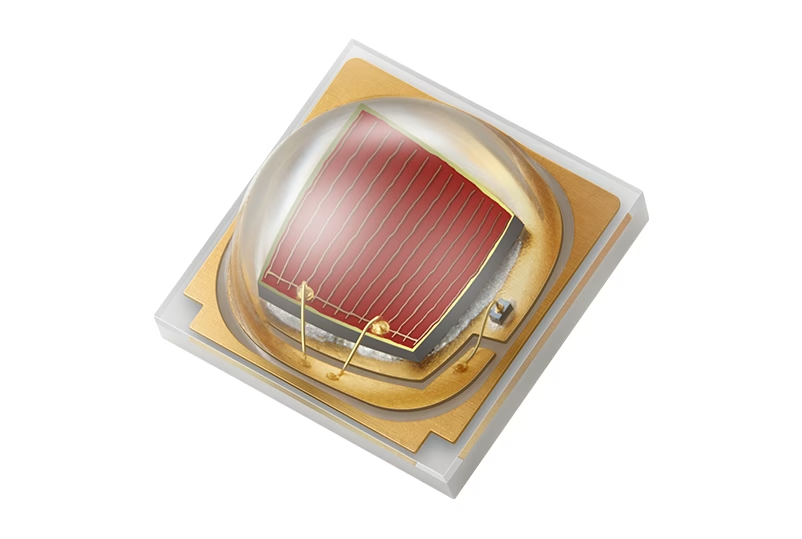
Producing high-quality 660nm LEDs requires separate production lines, specific epitaxial growth, complex binning, and a ton of degradation testing. At the same time, the LH351H, objectively speaking, was a good diode. But it entered a market already long and fiercely dominated by Osram with its Oslon Square line and the Cree XP series. The Germans had spent years relentlessly driving down the cost of a single micromole of red light. Seoul Semiconductor aggressively pushed their way in as well, slashing prices—and very successfully, in my opinion. As a result, the profit margins in the narrow segment of colored horticulture LEDs began to plummet, thanks to Seoul.
The Real Reason: Corporate Scale and ROI
Samsung’s management simply looked at the ROI of this fight over pennies and said, "Pass." Why butt heads with Osram in the red spectrum, wasting R&D resources, when you can just crush everyone with sheer volume in white? There’s already fierce competition with Nichia there!
That is exactly why the Korean strategy in agro-lighting is now maximally pragmatic. They are betting on the evolution of broad-spectrum white—just recall their LM301H EVO release with the shifted blue peak. They make the best base. But the heavy lifting in the narrow Deep Red (660nm) and Far Red (730nm) spectrums they have consciously left to their competitors.
So today, if someone tries to sell you a grow light that is "100% Samsung," including the red channels, you should be a little skeptical (but not too much) and ask for the datasheets—let them practice their Photoshop skills. Most likely, they are installing either old warehouse stock or a cheap Chinese remarked chip with a 99.1% probability. AliExpress is ahead of the rest of the planet in that regard.
The smartest and most honest architecture for a professional fixture today is a hybrid. A white base using Samsung matrices (or Seoul/Cree equivalents) plus proven red Osram chips—in 2026, that definitely means OSCONIQ. So, Samsung didn't lose this race. They just went where the real money is. And I'm going to miss them.