📋 Contents
DLI (Daily Light Integral) is the total amount of photosynthetically active photons (light) that fall on 1 square meter of a surface over a full 24-hour period. It is measured in mol/m²/d (micromoles per square meter per day).
While the PPFD metric tells us how brightly the lamp is shining right now (micromoles per second), the DLI shows how much total "light energy" the plant has accumulated over the entire day (moles per day).
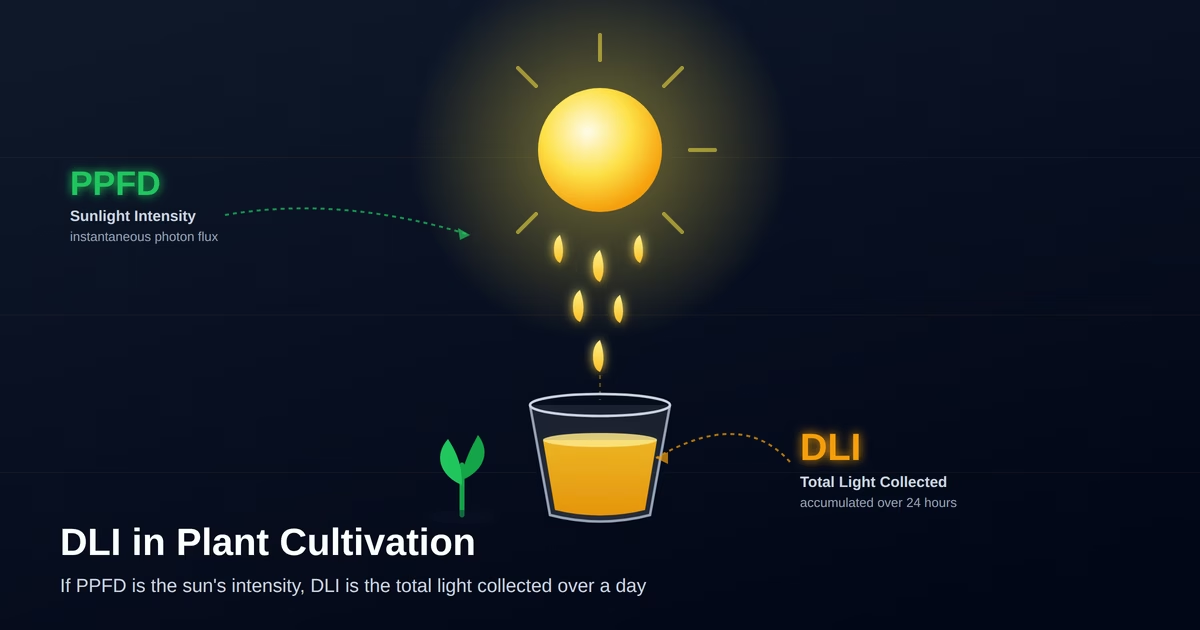
The Perfect Metaphor: Rain and Bucket
The best way to understand the difference between lighting metrics is to imagine that light is rain.
- PPFD (Flux Density) represents the intensity of the rain. For example, a light drizzle versus a heavy downpour.
- Photoperiod (Hours of operation) is how long the rain falls.
- DLI (Daily Integral) is how much water you ultimately collected in the bucket by the end of the day.
The calculation formula looks like this: DLI = PPFD × Hours × 0.0036.
From this formula comes the main rule of indoor growing: you can fill your "bucket" (reach the target DLI) in two ways. You can either turn on a very powerful lamp (high PPFD) for a short time, or use a weak lamp (low PPFD) but leave it shining for 18-20 hours. This rule is correct but with caveats: plants absolutely need night, even a short one, and if the lamp is too weak, you would have to extend the Earth's day from 24 to 36 hours, which is physically impossible.
Why is DLI more important than PPFD?
Plants do not "eat" light instantly; they accumulate energy throughout the entire day. It is DLI that determines the daily biomass gain, stem thickness, the speed of root system development, and the final fruit size.
Furthermore, every plant has its limit. If the DLI is too low, the plant stretches out, turns pale, and yields no harvest. If the DLI is too high, the chloroplasts become oversaturated, light burn occurs, and photosynthesis stops even if you add more nutrients. Knowing the optimal DLI allows you to save electricity by not wasting it on light that the plant physically cannot absorb. To force a plant to "eat" more light, artificial CO2 supplementation is used, which greatly activates the photochemical reaction process (photosynthesis).
How much DLI do different plants need?
Crop requirements differ drastically. Shade-loving microgreens need only a little "drizzle," whereas fruiting tomatoes require a real "light downpour."
| Crop Type | Optimal DLI (mol/m²/d) | Growth Phase |
|---|---|---|
| Microgreens, Orchids, Shade-loving | 6 – 12 | Full cycle |
| Lettuce, Basil, Culinary herbs | 12 – 17 | Vegetative phase |
| Cucumbers, Peppers, Strawberries | 22 – 30 | Flowering / Fruiting |
| Tomatoes, medical tomatoes (Light-demanding) | 30 – 40+ | Peak flowering (often requires CO2) |
Practical advice: Do not try to guess the DLI! Use our interactive DLI calculator (widget above) to find the perfect balance between your lamp's intensity (PPFD) and its running time for the specific growth stage of your plant! I hope the widget has helped many visually understand what DLI is.